Nine experienced ski-hikers walked into the northern Urals in the winter of 1959. None of them walked out. Their tent was found slashed open from the inside, their boots still stacked beside it, and their bodies scattered across a frozen slope and a snow-filled ravine more than a kilometre away.
For sixty years the Dyatlov Pass incident sat in a category of its own: a case with a full police file, nine autopsies and dozens of witnesses, yet no accepted explanation. Why leave a warm tent in socks at minus 25 degrees? Why did three hikers have injuries a pathologist compared to a car crash, but no bruising on the outside of the body? Why was a young woman found without her tongue?
Who Was Igor Dyatlov?
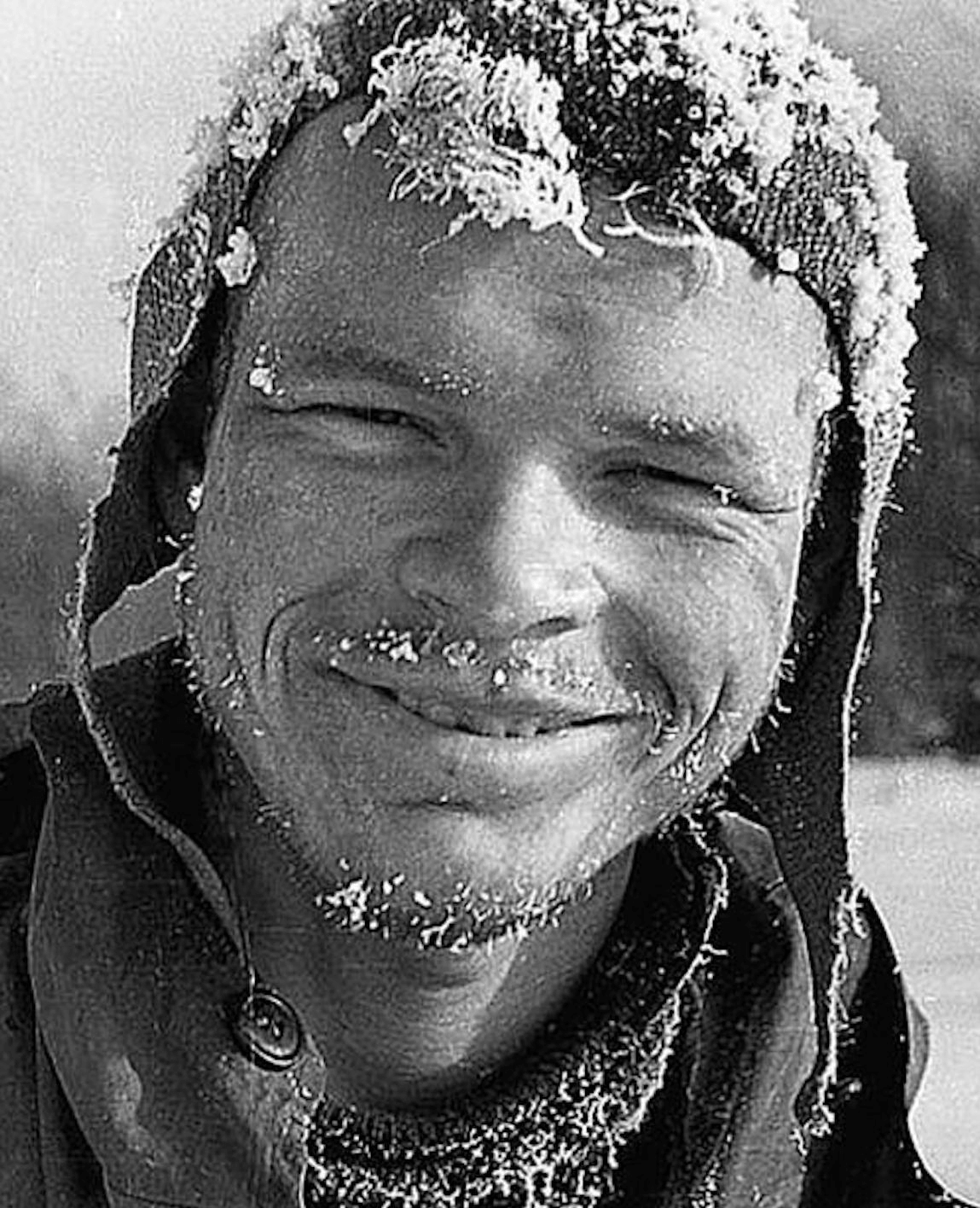
Igor Alekseyevich Dyatlov was 23, a fifth-year radio engineering student at the Ural Polytechnical Institute in Sverdlovsk (today’s Yekaterinburg). He was a seasoned winter trekker who designed some of the group’s own gear.
The route was rated Category III, the toughest grade in the Soviet system. The objective was Otorten, a peak roughly 10 kilometres north of where the group would eventually camp, and reaching it in February was meant to earn the team their top trekking certification.
The ten who set out were:
- Igor Alekseyevich Dyatlov, 23, leader
- Yuri Nikolayevich Doroshenko, 21
- Lyudmila Alexandrovna Dubinina, 20
- Georgiy (Yuri) Alexeyevich Krivonishenko, 23
- Alexander Sergeyevich Kolevatov, 24
- Zinaida Alekseyevna Kolmogorova, 22
- Rustem Vladimirovich Slobodin, 23
- Nikolai Vladimirovich Thibeaux-Brignolles, 23
- Semyon (Alexander) Alekseyevich Zolotaryov, 38, a war veteran and trekking instructor who joined late
- Yuri Yefimovich Yudin, 21, who turned back early
Yudin fell ill with joint pain during the first days on skis and left the group on 28 January. He lived until 2013 and, by his own account, never made peace with being the one who went home.
The Expedition Begins
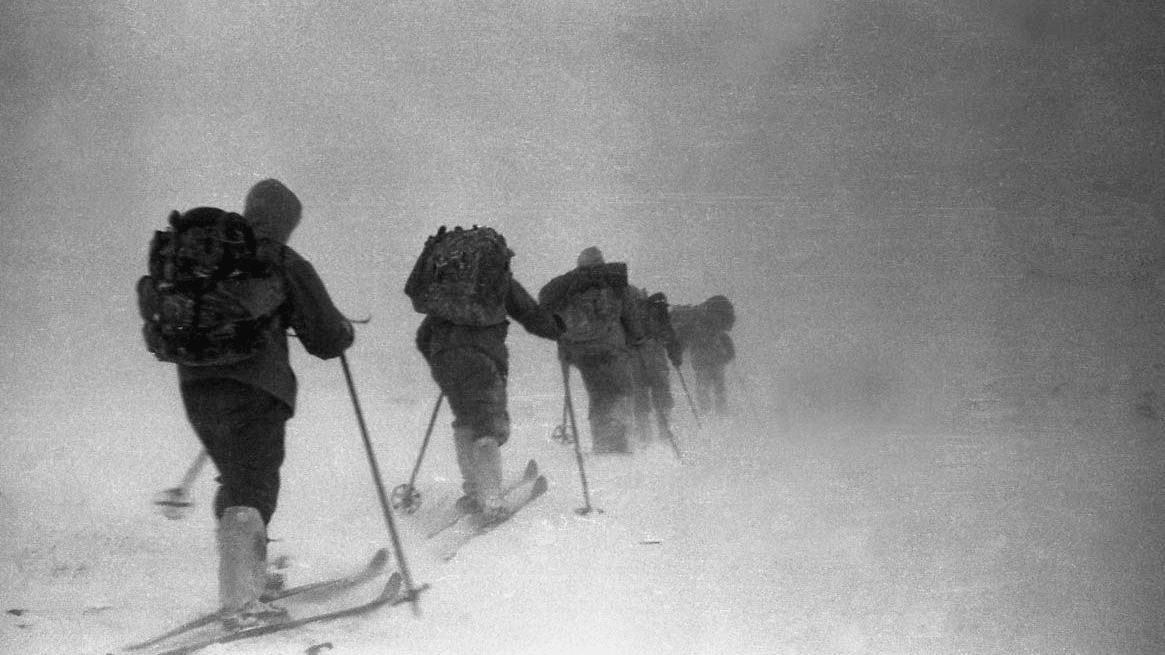
The team left Sverdlovsk by train on 23 January 1959, reached Ivdel two days later, and rode a lorry to the logging settlement of Vizhay on 26 January. On 27 January they set off on skis along the frozen Lozva and Auspiya rivers. The diaries and film recovered later show a cheerful, well-organised group.
On 1 February they climbed out of the forest and pitched their tent on the open eastern shoulder of Kholat Syakhl. The Mansi name is usually translated as “Dead Mountain”, though the local meaning is closer to “barren”. Dyatlov seems to have chosen the exposed spot deliberately, to avoid losing height before the push to Otorten.
They dug a platform into the snow, pitched the tent, ate, and settled in. Sometime that night, something made all nine of them leave.
The Search Operation
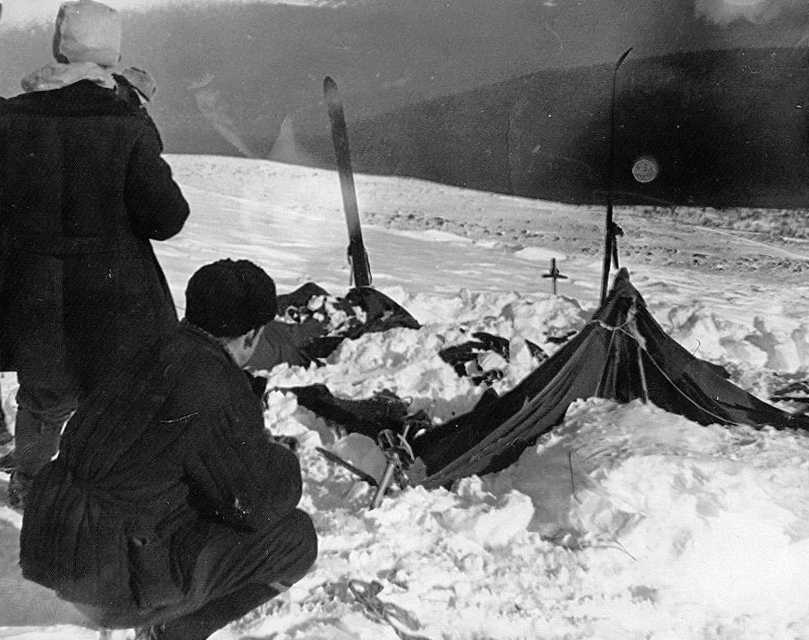
The group had promised to send a telegram from Vizhay around 12 February. When nothing arrived, relatives began pressing the institute, and by 20 February volunteer search parties were on the move, soon joined by soldiers, police and Mansi hunters who knew the terrain.
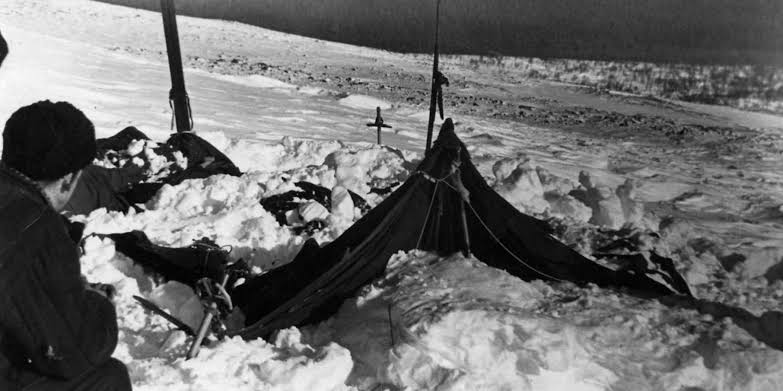
On 26 February 1959, searchers found the tent half-buried on the slope. The canvas had been cut from the inside in several places. Inside were the hikers’ boots, jackets, food and diaries, in reasonable order. A line of footprints, some barefoot, some in socks, led downhill towards the tree line about a kilometre and a half away. These were people walking, not stampeding.
The Disturbing Discoveries
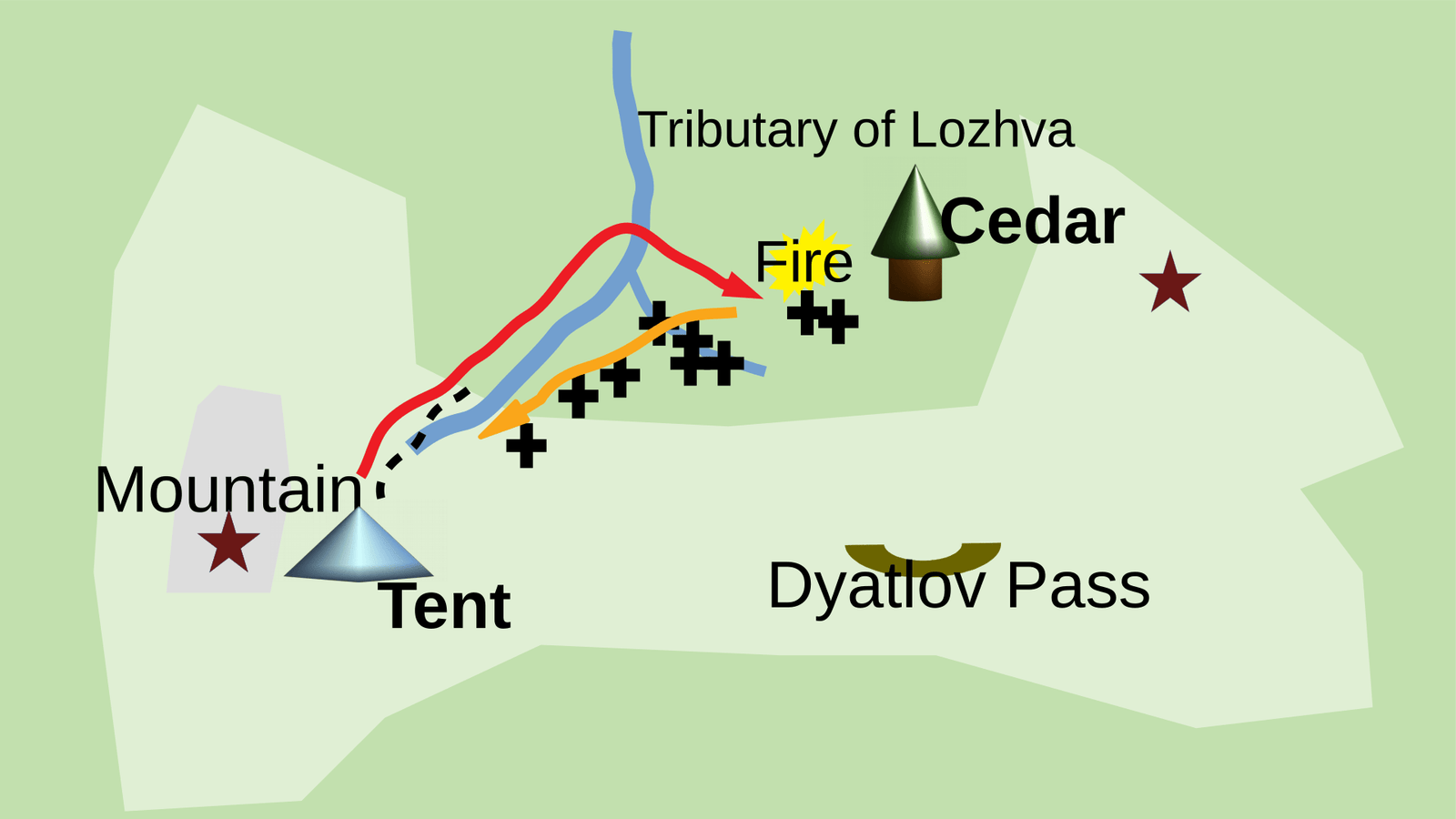
Under a tall cedar at the forest edge, on 27 February, searchers found Yuri Doroshenko and Georgiy Krivonishenko, both in their underwear, both dead of hypothermia. The remains of a small fire lay beside them, and branches had been snapped off the tree several metres up, as if someone had climbed it to look back towards the tent.
The same day, Igor Dyatlov and Zinaida Kolmogorova were found on the slope between the cedar and the tent. Rustem Slobodin was found on 5 March on the same line. All three faced uphill. They had been trying to get back.
The last four took another two months. On 4 May 1959, with the thaw underway, searchers dug into a ravine about 75 metres beyond the cedar and found Lyudmila Dubinina, Semyon Zolotaryov, Nikolai Thibeaux-Brignolles and Alexander Kolevatov under roughly four metres of snow. Nearby was a “den” of cut fir branches. Several of them wore clothing taken from the two men at the cedar, who had died first.
These four turned a tragedy into a mystery. Thibeaux-Brignolles had a severe skull fracture. Dubinina and Zolotaryov both had multiple broken ribs. Yet the forensic examiner, Boris Vozrozhdenny, noted no corresponding external wounds. The force, he said, was comparable to a car accident and could not have come from another person.
The case was closed on 28 May 1959. The official finding was death by a “compelling natural force”, a phrase vague enough to keep the argument alive for six decades.
Timeline of the Dyatlov Pass Incident
| Date | Event |
|---|---|
| 23 January 1959 | Ten trekkers leave Sverdlovsk by train |
| 25 January 1959 | Arrive in Ivdel |
| 26 January 1959 | Reach Vizhay by lorry |
| 27 January 1959 | Begin the ski route along the Lozva and Auspiya rivers |
| 28 January 1959 | Yuri Yudin turns back through illness; nine continue |
| 1 February 1959 | Final camp pitched on the slope of Kholat Syakhl |
| 12 February 1959 | Expected telegram from Vizhay; none arrives |
| 20 February 1959 | Search parties organised |
| 26 February 1959 | Tent found, cut open from inside |
| 27 February 1959 | Doroshenko and Krivonishenko found at the cedar; Dyatlov and Kolmogorova on the slope |
| 5 March 1959 | Slobodin found on the slope |
| 4 May 1959 | Dubinina, Zolotaryov, Thibeaux-Brignolles and Kolevatov found in the ravine |
| 28 May 1959 | Case closed: death by a “compelling natural force” |
| February 2019 | Prosecutor General’s Office reopens the inquiry |
| 11 July 2020 | Official conclusion announced: a snow avalanche |
| 28 January 2021 | Gaume and Puzrin publish their slab-avalanche model |
The Major Theories
Avalanche
The original and simplest idea: snow slid onto the tent, the hikers cut their way out, retreated to the trees to wait, and froze. For decades this was dismissed because the slope looked too gentle, there was no debris field, and the tent was still standing when found.
Military Testing
Because the Urals held closed military zones, many suspected the group had stumbled into a weapons test. Supporters point to traces of radioactivity on a few items of clothing and reports of “glowing spheres” in the sky that month. No document, witness or physical trace has ever tied the site to a test, and the radiation is more easily explained by Krivonishenko’s work at a nuclear facility.
Paranormal and UFO Claims
Yeti-like creatures, alien lights and Mansi curses have all been proposed. They persist because the case is genuinely strange, not because anything supports them. The Mansi, briefly suspected in 1959, were cleared quickly.
Infrasound and Katabatic Winds
The writer Donnie Eichar argued that wind curling around the summit of Kholat Syakhl could form a Kármán vortex street, producing low-frequency sound that causes dread and panic. A 2019 Swedish-Russian expedition suggested instead that violent downslope katabatic winds forced the hikers out. Neither idea is impossible. Neither explains broken ribs and a crushed skull.
What Really Happened at Dyatlov Pass?
Two developments between 2019 and 2021 changed the picture.
The 2020 Prosecutor General’s conclusion
In February 2019, Russia’s Prosecutor General’s Office reopened the file. Investigators visited the site in winter, took measurements, ran forensic experiments and narrowed the possibilities to three natural causes: an avalanche, a snow slab, or hurricane-force wind.
On 11 July 2020, Andrei Kuryakov, deputy head of the office’s Urals directorate, announced the result. An avalanche, triggered by a sudden change in weather, had struck the tent. The group cut their way out and moved about 50 metres downhill to a rocky ridge, a sensible place to shelter. But visibility that night was around 16 metres. When they tried to return, they could not see the tent. In conditions the office put at minus 40 to minus 45 with wind chill, they headed for the forest, lit a fire, and died of hypothermia, apart from the three whose injuries Kuryakov described as typical of climbers caught in an avalanche.
He addressed the “no external wounds” puzzle with an analogy: press a ball from all sides and then push on top, and it fails on the side opposite the force. Bodies compressed by snow can break inside without bruising outside.
The 2021 slab-avalanche model
Six months later, Johan Gaume of EPFL in Lausanne and Alexander Puzrin of ETH Zurich published a paper in the Nature journal Communications Earth & Environment that gave the avalanche story a physical backbone. Their argument, put simply:
1. The slope was steeper than it looked. Earlier estimates put it at about 23 degrees, below the usual avalanche threshold. Terrain analysis showed the section above the tent was closer to 30 degrees, with a weak, sugary layer buried beneath a firmer slab. 2. The hikers cut the slope themselves. Digging a flat platform for the tent removed the support from the snow above, creating a step a slab could break away from. 3. The wind did the rest. Katabatic winds carried snow across the mountain’s shoulder and piled it above the tent for hours. The load built slowly, which is why the slab released not when they dug but roughly nine hours later, while they slept. 4. The slab was small. A block only a few metres long, roughly the size of a car, was enough. It would have hit the tent, partly buried it, and then been hidden by more drifting snow. 5. Skis explain the injuries. The group had laid their skis flat under their bedding. Snow landing on a body lying on a rigid surface breaks ribs and skulls far more easily than on soft ground. The researchers checked this against injury-threshold data from old General Motors crash tests on cadavers, a standard source in impact biomechanics. The forces matched.
Follow-up expeditions in 2021 and 2022 recorded fresh slab avalanches on the same slope, confirming the terrain is avalanche-prone after all. Gaume and Puzrin published those findings in a second paper in March 2022.
Is the Dyatlov Pass Incident Solved?
Officially, yes. The Russian state has a closed case with a stated cause: avalanche, exposure and trauma. The science published since supports it and has survived peer review and field checks.
Publicly, it is still contested. A lawyer for the foundation representing the families said after the 2020 announcement that the relatives did not accept the avalanche explanation. Critics raise fair points. The tent was still upright, if flattened, when found. The footprints were orderly. Nobody has fully explained why the group walked 1.5 kilometres to the forest rather than sheltering nearer their gear. And the Soviet investigation was so poorly documented that some questions can never be settled.
The fair summary: the Dyatlov Pass incident has a well-supported natural explanation that accounts for every major piece of physical evidence, including the injuries once thought impossible. What it lacks is courtroom proof and a version everyone can accept emotionally. As Gaume has observed, people struggle with the avalanche answer not because it is weak, but because it is ordinary.
Cases that end with an official answer but no public closure are more common than you might think, and few illustrate it better than Norway’s Isdal Woman, whose death was ruled a suicide that almost nobody believes.
Lyudmila Dubinina and the Ravine Four
No name from the case is searched more often than Lyudmila Dubinina’s, so it is worth setting out what was actually found.
Dubinina was 20, an economics student, and by every account the liveliest member of the group. She was found on 4 May kneeling against a rock in a small stream in the ravine, having lain under snow and meltwater for over two months. The autopsy recorded multiple rib fractures on both sides of her chest, with internal bleeding. That was the cause of death.
The details that shocked readers were the missing soft tissues: her tongue, eyes, part of the lips, and some facial skin. Zolotaryov, lying near her, was also missing his eyes. There is no forensic mystery here. Exposed tissue in running water breaks down first, and scavengers take the most accessible parts of a body. The 1959 examiner attributed the losses to decomposition, and nothing found since contradicts him. The idea that her tongue was “removed” belongs to fiction, not the case file.
The picture for the ravine four is coherent and sadly human. Dubinina, Zolotaryov and Thibeaux-Brignolles were sleeping closest to the slope, where the slab hit hardest. Their companions helped them down to the forest, built a fire, then dug a den in the ravine and lined it with fir branches. Kolevatov, who had no serious fractures, was found beside Zolotaryov, apparently having stayed with him. Clothing from Doroshenko and Krivonishenko, already dead at the cedar, had been cut off and given to the injured. Then the snow above the ravine collapsed, or simply built up, and buried them.
They did not run screaming from something unknown. They tried to save each other.
It is not the only case where bodies in a remote mountain setting were badly misread for decades; the Roopkund skeleton lake mystery in the Indian Himalaya followed a similar path from folklore to forensic science.
Dyatlov Pass Incident: Frequently Asked Questions
What is the Dyatlov Pass incident, explained simply?
In February 1959, nine ski-hikers from the Ural Polytechnical Institute died on Kholat Syakhl in the northern Urals. They cut their way out of their tent at night, walked to the forest without proper clothing, and died of hypothermia and injuries. The pass was later named after the group’s leader, Igor Dyatlov.
What really happened at Dyatlov Pass?
The best-supported explanation is a small slab avalanche. Wind-blown snow piled up above the tent, which the group had dug into the slope, and a slab released hours later. It injured three hikers; the group retreated to the trees, lost sight of the tent in near-zero visibility, and froze. This is the conclusion of the 2020 Russian inquiry and the 2021 Gaume and Puzrin study.
Has the Dyatlov Pass mystery been solved?
Officially, yes: the Prosecutor General’s Office closed the case in July 2020 with avalanche as the cause. Publicly, many relatives and researchers still disagree, mainly because the original 1959 investigation was so incomplete.
What happened to Lyudmila Dubinina?
Dubinina died of massive chest trauma, consistent with being compressed by snow while lying on a rigid floor of skis. Her missing tongue, eyes and facial tissue were the result of more than two months in a stream under snow, not an injury inflicted while she was alive.
Why did the hikers leave the tent without their boots?
Because they believed they had seconds, not minutes. A slab hitting a tent in the dark, with a larger release possibly behind it, is exactly what mountaineers are trained to escape at once. They meant to return for their gear once it was safe, and never found the tent again.
Conclusion
The Dyatlov Pass incident survives as a mystery partly because of Soviet secrecy, partly because of the injuries, and partly because a good mystery is hard to give up. Strip away the folklore and the sequence is reasonably clear: a small slab avalanche in the dark, a disciplined retreat, injuries made worse by a rigid floor, and a night so cold that nine strong young people could not survive it.
That is not the shocking truth many expected. It is a quieter one. And for the families who spent sixty years asking, it may be the closest thing to an answer they will get.
Sources
- Wikipedia, “Dyatlov Pass incident” – https://en.wikipedia.org/wiki/Dyatlov_Pass_incident
- TASS, “Prosecutors say avalanche killed Dyatlov group in Urals in 1959” (11 July 2020) – https://tass.com/emergencies/1177345
- RFE/RL, “Russian Officials Reportedly Close Investigation Into Mysterious 1959 Hiking Disaster” (July 2020) – https://www.rferl.org/a/russian-officials-reportedly-close-investigation-into-mysterious-1959-hiking-disaster-dyatlov/30722068.html
- Gaume, J. and Puzrin, A. M., “Mechanisms of slab avalanche release and impact in the Dyatlov Pass incident in 1959”, Communications Earth & Environment (28 January 2021) – https://www.nature.com/articles/s43247-020-00081-8
- Puzrin, A. M. and Gaume, J., “Post-publication careers: follow-up expeditions reveal avalanches at Dyatlov Pass”, Communications Earth & Environment (24 March 2022) – https://www.nature.com/articles/s43247-022-00393-x
- ETH Zurich, “The Dyatlov Pass mystery and what a research article can trigger” (March 2022) – https://ethz.ch/en/news-and-events/eth-news/news/2022/03/the-dyatlov-pass-mystery-and-what-a-research-article-can-trigger.html
- National Geographic, “Has science solved one of history’s greatest adventure mysteries?” (28 January 2021) – https://www.nationalgeographic.com/premium/article/has-science-solved-history-greatest-adventure-mystery-dyatlov
- History.com, “The Dyatlov Pass Incident: Why the Hiker Deaths Remain a Mystery” – https://www.history.com/articles/dyatlov-pass-incident-soviet-hiker-death-mystery
- Russia Beyond, “Official cause of death of the Dyatlov group revealed” (July 2020) – https://www.rbth.com/history/332434-official-cause-of-death-of-the-dyatlov-group
- Wikimedia Commons, File:Dyatlov_Pass_incident_02.jpg (tent photograph, 26 February 1959) – https://commons.wikimedia.org/wiki/File:Dyatlov_Pass_incident_02.jpg