Among the many creatures in Scottish folklore, few are as disturbing as the Nuckelavee. Unlike mythical beings that occasionally deceive, bargain or even help humans, this creature was associated almost entirely with destruction. Its appearance is horrifying, but what made it particularly feared was the belief that simply being near it could bring suffering to an entire community.
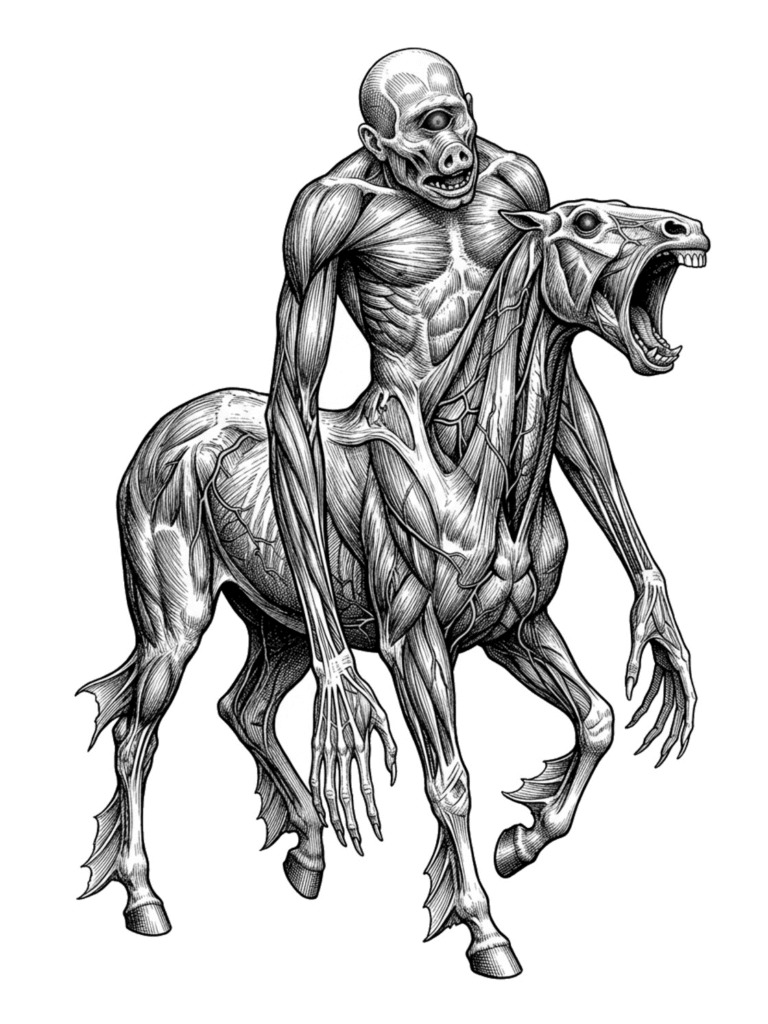
Source: Crazy Alchemist
Originating in the folklore of the Orkney Islands, off the northeastern coast of Scotland, the Nuckelavee is described as a skinless monster that emerged from the sea to spread disease, ruin crops and torment livestock. Its reputation was so dreadful that islanders were said to avoid speaking its name without offering a prayer immediately afterwards.
Also Read: Spring-Heeled Jack: The Phantom of Victorian England
A Monster Unlike Any Other
The Nuckelavee is believed to inhabit the sea, only coming ashore when it wishes to unleash its cruelty upon the land. Its appearance is unlike that of a conventional sea monster. Instead, it resembles a grotesque combination of a horse and a human, with both forms seemingly fused into a single creature.
According to the descriptions recorded in Orcadian folklore, its horse-like body was enormous, while a human-shaped torso rose from its back. The rider was not an ordinary figure sitting on a horse but an inseparable part of the same monstrous being. However, it was the creature’s skinless appearance that made the description particularly unsettling. Its exposed body revealed raw flesh, powerful muscles, white sinews and black blood flowing through yellow veins. The human-like head was disproportionately large, with a single enormous eye and a wide mouth. Its limbs were equally unnatural, with long arms that nearly reached the ground.
Source: The terrifying myth of Orkney’s horse demon, Nuckelavee
The Nuckelavee’s presence is not limited to physical terror. Its breath is believed to be poisonous, capable of withering vegetation, infecting animals and bringing disease to humans. For communities whose survival depended heavily on farming and livestock, such a creature represented a particularly devastating threat.
Another important element of the legend is the creature’s inability to tolerate fresh water. Although it can emerge from the sea and travel across land, a stream or river is believed to be enough to stop it. Anyone unfortunate enough to encounter the Nuckelavee can potentially escape by crossing a stretch of running freshwater. The creature is also associated with the Mither o’ the Sea or Mother of the Sea, a powerful female spirit in Orcadian folklore. She is believed to restrain the Nuckelavee during the summer months, preventing it from causing widespread destruction. With her influence weakening during winter, and the Teran (the spirit of winter and storm) taking over, the monster is believed to become particularly dangerous.
Tammas and His Encounter with the Creature

Perhaps the most memorable account of the Nuckelavee is the story of an islander named Tammas, recorded by the Orcadian folklorist Walter Traill Dennison. Dennison published the account in The Scottish Antiquary in the late nineteenth century. He claimed to have known Tammas personally and described how the man reluctantly recounted an encounter with the creature.
One night, while walking along a road between the seashore and a freshwater loch, Tammas noticed a strange figure approaching him. As it came closer, he realised that it was no ordinary animal or human. The creature’s appearance left him terrified. Its enormous body, exposed flesh and unnatural features made it unlike anything he had encountered before. Realising it was the Nuckelavee and its supposed aversion to freshwater, Tammas ran towards the nearby freshwater loch. At one point, water splashed against the creature’s foreleg. According to Dennison’s account, the horse-like monster reacted violently, letting out a thunderous snort and moving away from the water.
Tammas took the opportunity to escape. He eventually crossed a small running stream, which prevented the creature from following him. The Nuckelavee made one final attempt to reach him, reportedly catching his bonnet, before retreating with a terrible cry of frustration. The story became one of the most frequently retold accounts associated with the creature, offering a glimpse into just how deeply the legend had taken hold in local imagination.
Source: The Nuckelavee
The Origins of an Enduring Orcadian Legend
Much of what is known about the Nuckelavee comes from Walter Traill Dennison’s nineteenth-century writings. His account remains the principal surviving source for the creature’s appearance, behaviour and associated stories. The name and characteristics of the Nuckelavee are also often connected to older Norse and Scandinavian traditions. The Orkney Islands have a long Norse cultural history, and some folklorists have linked the creature to water spirits such as the Old Norse nykr, a supernatural being associated with water and shapeshifting.
There are also similarities between the Nuckelavee and the water-horse traditions found elsewhere in Scotland and the Northern Isles. However, its unusually grotesque appearance and association with disease and destruction give it a distinctive place in Orcadian folklore. Despite its fearsome reputation, the Nuckelavee remains a figure of folklore rather than a creature supported by historical evidence. Its stories nevertheless preserve something of the fears and hardships experienced by island communities living in close dependence on the natural world.
Even among Scotland’s many legendary creatures, the Nuckelavee stands apart. It was not remembered for granting wishes or testing human courage, but for the devastation it supposedly left behind. Perhaps that is what makes the legend so unsettling.
Also Read: Sebastian Rogers: The Disappearance of a Tennessee Teenager